
Table of Contents
- What You’ll Need Before You Start
- Step 1: Measure Where Your Kitchen Operational Efficiency Actually Stands
- Step 2: Fix Restaurant Kitchen Workflow Optimisation Before You Buy Anything
- Step 3: Cut Reducing Food Waste in Commercial Kitchens With a Stock Rotation Reset
- Step 4: Choose Digital Inventory Management Systems for Restaurants That Fit Your Volume
- Step 5: Build Kitchen Staff Retention Strategies 2026 That Survive a Busy Friday
- Step 6: Balance Speed and Food Quality Without Burning Out the Pass
- Step 7: Review, Adjust and Lock In Your Kitchen Operational Efficiency Gains
- Frequently Asked Questions
Last Updated: 16 September 2026
What You’ll Need Before You Start
Improving kitchen operational efficiency is the practice of removing waste, friction and guesswork from how a kitchen buys, preps, cooks and serves. It rewards preparation over spending, and it starts with five things: a week of honest data, a printed workflow map, a named owner for each change, a stock rotation routine, and a realistic timeline of eight to twelve weeks.
This guide from Operational Chef Consultant covers seven steps, in order, because sequence matters. Skip the measuring stage and you will buy software to fix a problem you never diagnosed. The Food Standards Agency guidance on food safety management is a useful reference point throughout, since any change to workflow or storage must keep your food safety management system intact.
Before you touch anything, walk the kitchen at the start, middle and end of a single service and write down every time someone leaves their station to fetch something. That list is usually the single clearest picture of where efficiency is leaking.
Step 1: Measure Where Your Kitchen Operational Efficiency Actually Stands
You cannot improve kitchen operational efficiency without a baseline, so pick five numbers and track them weekly. Most kitchens already hold this data in rotas, invoices and wastage sheets. The work is compiling it, not collecting it.
The Five Numbers Worth Tracking Weekly
| Metric | What It Shows | How to Capture It |
|---|---|---|
| Labour cost as % of sales | Whether rota hours match revenue | Rotas vs weekly till reports |
| Food cost as % of sales | Purchasing and portioning discipline | Supplier invoices vs sales |
| Wastage value | Spoilage and over-prep | Wastage log, weighed where possible |
| Covers per labour hour | Throughput of the team | Covers divided by hours worked |
| Ticket time at peak | Whether the pass is a bottleneck | Timestamp a sample of orders |
Track these for two weeks before changing a thing. A common mistake is benchmarking against another site’s numbers when your menu, cover count and equipment are different. Your own trend line is the only comparison that matters.
Step 2: Fix Restaurant Kitchen Workflow Optimisation Before You Buy Anything
Restaurant kitchen workflow optimisation is the redesign of how food and people move through the space, and it costs nothing but attention. Watch where dishes queue, where chefs cross paths, and which station always falls behind at peak.
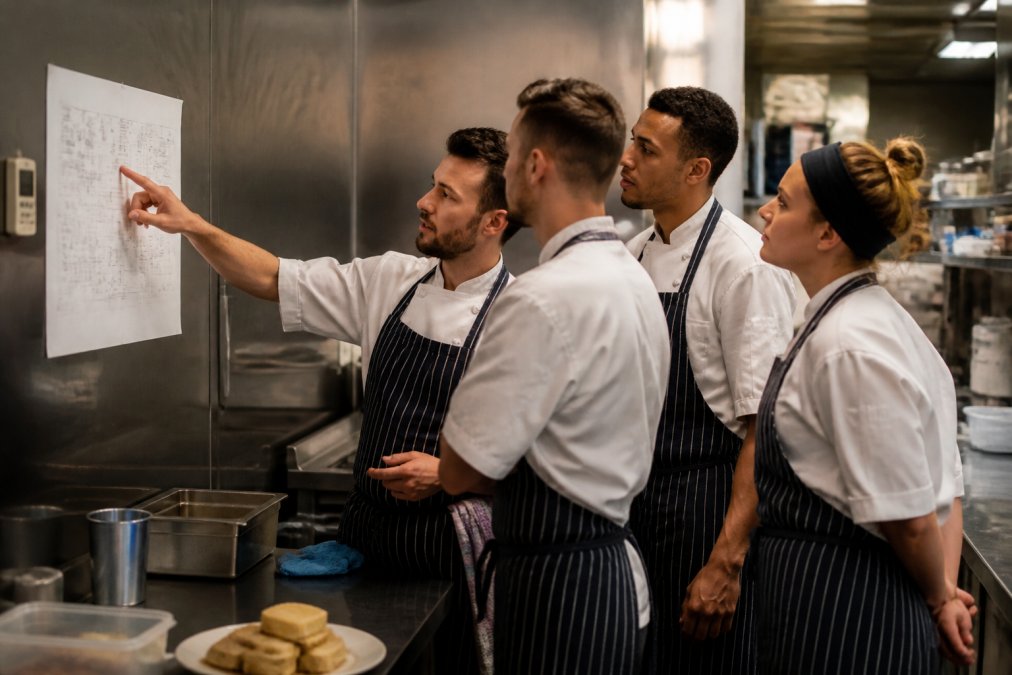
The classic fixes are unglamorous. Move the most-used ingredients within arm’s reach of the station that uses them. Separate raw prep from plating so nobody crosses a contamination line mid-service. Give the pass a single caller rather than three people shouting orders. According to the Health and Safety Executive’s guidance on kitchen and catering safety, layout and traffic flow also affect slip and burn risks, so a workflow fix is often a safety fix too.
Buying equipment to solve a layout problem is the most expensive mistake in this list. A new combi oven does not fix a pass where tickets pile up because the plating station is two metres from the heat lamps.
Step 3: Cut Reducing Food Waste in Commercial Kitchens With a Stock Rotation Reset
Reducing food waste in commercial kitchens begins with a stock rotation reset: one labelled system, checked daily, owned by one person. Waste is rarely a staff attitude problem. It is almost always a storage and ordering problem wearing a disguise.
Set up a first-in-first-out system with dated labels on every container, and give one senior chef responsibility for the walk-in and dry store. Then change how you order: build the week’s prep list from the stock you already hold before you place a supplier order. Kitchens that prep from stock rather than from habit tend to see wastage fall within the first month, because they stop buying twice for the same dish.
Start with three actions:
- Date and label every container on delivery day
- Run a five-minute stock check before each order is placed
- Log every item binned, with the reason, for two weeks
That log will tell you more about your menu than any consultant’s report.
Step 4: Choose Digital Inventory Management Systems for Restaurants That Fit Your Volume
Digital inventory management systems for restaurants only pay for themselves when they match your volume and your team’s willingness to use them. A small independent doing 60 covers a night does not need the same system as a hotel with three outlets and a banqueting operation.
Match the tool to the operation:
- Under 80 covers a day: a shared spreadsheet with a strict daily routine beats most software.
- 80 to 200 covers: a mid-tier system with supplier integration and recipe costing.
- Multiple outlets or banqueting: a full platform with central purchasing and per-site reporting.
What to Check Before You Sign a Contract
Ask three questions before committing. Can it import your existing supplier invoices without manual re-entry? Does it calculate recipe-level costing when a supplier price changes? Can a chef update stock in under two minutes on a busy Friday, or will the system be abandoned by week three? Pricing depends on outlet count and modules, so request a quote rather than relying on published tiers.
The best inventory system is the one your team actually updates during service. A simple tool used daily outperforms a sophisticated one used monthly.
Step 5: Build Kitchen Staff Retention Strategies 2026 That Survive a Busy Friday
Kitchen staff retention strategies 2026 have to survive the reality of a packed Friday, not a training room. Retention is decided in the worst two hours of the week, not the best.
Three things drive chefs out of a kitchen: unpredictable rotas, a chaotic pass, and no visible progression. Fix the rota first, published at least two weeks ahead and honoured. Then fix the pass, because a kitchen where one person is always drowning loses that person within months. Finally, show a route forward: a commis who can see the next step stays longer than one who cannot.
Where you have a genuine gap, bring in vetted temporary chef cover rather than stretching the existing team into burnout. Operational Chef Consultant provides hand-screened, DBS-checked chefs deployed across London and the UK, often within hours, which keeps service running while you recruit permanently.
Step 6: Balance Speed and Food Quality Without Burning Out the Pass
Speed and quality are not opposites, but they are traded every service, and the pass is where the trade is made. The way to protect both is to standardise the dishes that do not need creativity and reserve chef judgement for the ones that do.
Write a one-page spec for every dish: portion weights, plating order, and the target ticket time. This removes the small decisions that slow a station down. Then protect quality by building in a genuine pause: a two-minute check before the pass calls away, not after the plate has left.
A common mistake is adding staff to fix a speed problem that is really a menu problem. If a dish cannot be executed at peak volume with your current equipment, it belongs in a different section of the menu or off it entirely.
Step 7: Review, Adjust and Lock In Your Kitchen Operational Efficiency Gains
Gains slip unless they are reviewed, so put a 30-minute meeting in the diary every month and keep the five baseline numbers in front of you. Compare this month to the same month last year where possible, since seasonality distorts week-to-week comparisons.
Lock in what works by writing it into your standard operating procedures and your food safety management system, so a new starter inherits the improvement rather than undoing it. Drop anything that added admin without moving a number.
If you want the diagnosis done properly, Operational Chef Consultant offers business consultancy covering kitchen management, operational structure and revenue growth, with 78+ clients across the UK and over 25 years of combined team experience.
Frequently Asked Questions
How can I reduce food waste to improve kitchen efficiency?
Start with a two-week waste audit: weigh and log everything binned at the end of each service, split by prep waste, spoilage and plate waste. Most kitchens find spoilage and over-prep are the biggest categories. Then tighten your stock rotation, move to smaller and more frequent deliveries, and adjust prep lists to match actual covers. Reducing food waste in commercial kitchens works best when it is tied to one number you review weekly, such as waste cost as a percentage of food sales.
What role does staff training play in kitchen operational performance?
Training is the difference between a workflow that works on paper and one that holds during a Friday rush. Short, repeated sessions on station setup, portion control and handover notes beat one long induction day. Pair each new starter with a named buddy for their first two weeks, and record who has been signed off on each station. This also supports kitchen staff retention strategies 2026, because people who feel competent and supported are far less likely to leave within six months.
How can digital inventory management improve kitchen margins?
Digital inventory management systems for restaurants replace guesswork with live stock levels, so you order against actual usage rather than habit. That cuts both spoilage and emergency top-up runs, which are usually the most expensive way to buy. Look for a system that links recipes to stock so the cost of a dish updates when supplier prices change, and check it can handle your delivery pattern and supplier list before you commit. The margin gain comes from fewer surprises, not from the software itself.
How do I balance kitchen speed with food quality in 2026?
Decide which dishes can be pre-prepped and held, and which must be fired to order, then build your menu around that split. A menu with too many à la minute dishes will always slow the pass and push error rates up. Track ticket times by station for a fortnight, find the station that bottlenecks first, and either simplify its dishes or add a prep step earlier in the day. Speed and quality are not opposites if the prep happens before service starts.
